

Boat Tours of Mussel Farms in Galicia Explained
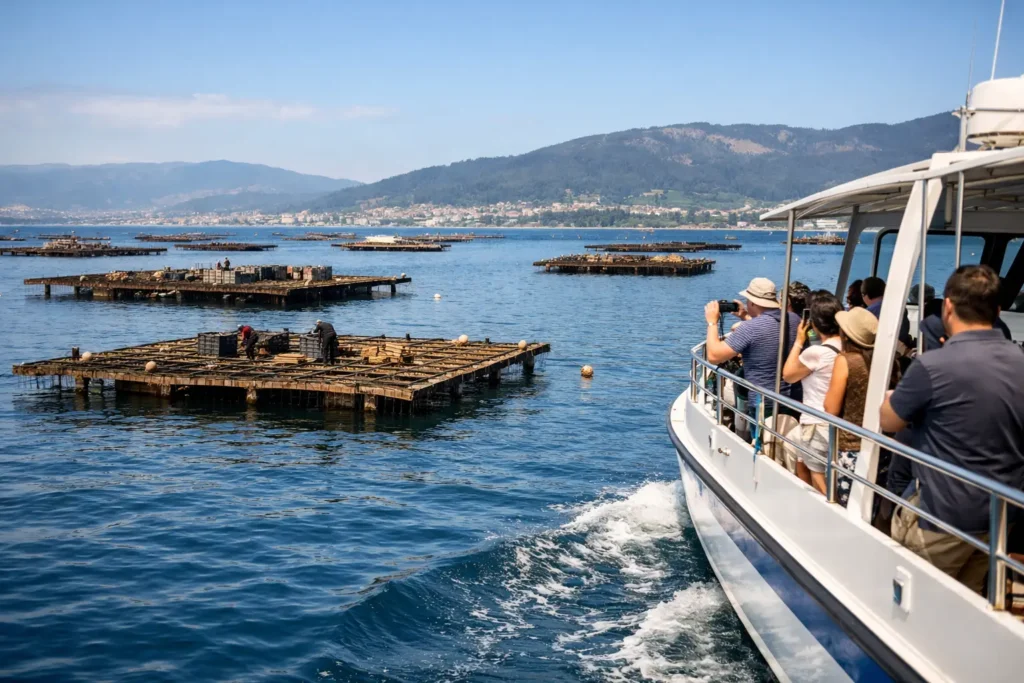
The first surprise on a boat tour mussel farms Galicia experience is the scale. From the shore, the wooden platforms floating across the estuary can look like a quiet grid on the water. Up close, they reveal one of Galicia’s most important living landscapes: the bateas, or floating rafts, where mussels grow beneath the surface of the Rías Baixas.
This is not simply a scenic cruise. It is a chance to understand why Galician mussels are so closely tied to local cuisine, coastal towns, and the Atlantic tides. For travelers who enjoy seafood, culture, and views that cannot be reached by road, a mussel farm boat trip offers a very local way to experience the coast.
What you see on a boat tour of mussel farms in Galicia
Most tours take place in the sheltered estuaries of the Rías Baixas, especially the Ría de Arousa, although experiences may also operate in the rías of Vigo, Pontevedra, or Muros-Noia. These rías are where Atlantic seawater meets freshwater flowing from inland, creating nutrient-rich conditions that support marine life.
As the boat leaves the marina, the shoreline gradually opens into a broad expanse of water dotted with bateas. Each raft is anchored in place and supports long ropes that hang vertically below the surface. Mussels attach themselves to these ropes and grow in the moving water, feeding naturally on microscopic plankton.
A guide or crew member will usually explain the process as you pass through the farms. Depending on the itinerary and the working conditions that day, you may see boats tending the rafts or harvesting mussels. It is an active industry, not a museum display, so every trip can look a little different.
The views are part of the experience as well. Low green hills, fishing villages, beaches, and distant islands frame the ría. On clear days, the light on the water makes it easy to understand why this coast is best appreciated from a boat rather than only from a roadside viewpoint.
The bateas: Galicia’s floating mussel farms
Bateas are the iconic wooden rafts used for mussel cultivation in Galicia. They are designed to float while holding dozens of ropes under the water, sometimes reaching considerable depths. Young mussels, known locally as seed mussels, are attached to the ropes and left to develop in the ría’s naturally favorable conditions.
The process requires knowledge, timing, and constant care. Producers monitor growth, clean the ropes when necessary, and harvest according to regulations and market demand. Galicia is one of Europe’s leading mussel-producing regions, and the bateas are a visible reminder that local seafood begins long before it reaches a restaurant plate.
For visitors, this makes the boat ride more meaningful. You are not just looking at a picturesque coastal scene. You are traveling through a working food landscape shaped by families, fishing traditions, tides, and generations of practical experience.
Why the Rías Baixas are ideal for mussels
The Rías Baixas are more than beautiful inlets. Their geography is central to the quality and abundance of the seafood produced here. The estuaries are protected enough for boats and rafts, yet remain connected to the Atlantic. This circulation brings fresh, oxygenated, nutrient-rich water into the growing areas.
That natural movement is one reason Galician mussels have a firm texture and a pronounced sea flavor. The waters also support oysters, clams, scallops, and other shellfish, which is why a trip through the rías often becomes an introduction to Galicia’s wider seafood culture.
It is worth remembering that mussel cultivation depends on the health of the water. Shellfish production is carefully monitored, and harvesting can be temporarily restricted when conditions require it. This is normal in a responsible coastal industry. If a planned activity includes a tasting, availability may occasionally vary for the same reason.
What a typical mussel farm boat trip includes
The exact format depends on the departure port and operator, but most experiences are short enough to fit easily into a day around the Rías Baixas. Expect a relaxed ride through the estuary, commentary about the bateas and local marine life, and time to take photos from the deck.
Many trips also include a tasting of steamed mussels, often served with local bread and a glass of regional wine or a nonalcoholic drink. It is a simple tasting rather than a formal seafood meal, but for many travelers it becomes the highlight. Eating mussels while floating near the farms where they were grown gives the experience an immediate sense of place.
Some routes add views of islands, old fishing ports, or coastal landmarks. Others focus almost entirely on the farms and the cultivation process. Neither option is automatically better. Choose a more focused tour if you are especially interested in gastronomy and local industry; choose a wider estuary route if scenery and time on the water are your priorities.
How to choose the right boat tour
The best departure point depends largely on where you are staying. Travelers based in Santiago de Compostela often combine a boat trip with a full-day Rías Baixas excursion, avoiding the need to rent a car or coordinate several separate transfers. If you are staying in Vigo, Pontevedra, O Grove, Cambados, or other coastal towns, a direct marina departure can be more convenient.
Before reserving, check the duration, meeting point, language of the commentary, and whether a tasting is included. These details matter more than a generic description of a “mussel tour.” A family with young children may prefer a shorter, calmer outing, while food-focused travelers may want a route with a more substantial tasting and explanations of shellfish cultivation.
Cruise passengers should be particularly careful about timing. A ría boat trip can be a memorable addition to a stop in Vigo, but the schedule needs to leave a comfortable margin for returning to the port. Booking a coordinated shore experience is often the simplest option when your time ashore is limited.
Practical details to know before you go
Weather on the Galician coast can change quickly, even in warmer months. Bring a light waterproof layer and an extra layer for the breeze on deck. Sunscreen is useful on bright days because reflected light from the water can feel stronger than expected.
Wear shoes with a good grip, especially if the deck may be wet. Most sightseeing boats are suitable for a wide range of travelers, but accessibility varies by vessel and boarding point. If anyone in your group has reduced mobility, confirm the access arrangements before booking rather than assuming every marina and boat will have the same facilities.
Seasickness is usually less of a concern inside the rías than on an open-sea trip, as the estuaries are relatively sheltered. Still, conditions depend on wind and tide. Travelers who are sensitive to motion may prefer a morning departure, take their usual precautions, and choose a shorter route.
The best time for a Galicia mussel farm tour
Boat tours generally operate most often from spring through early fall, when visitor demand and daylight hours are higher. Summer brings warm temperatures and lively coastal towns, but it also brings more visitors. Reserving ahead is sensible if you are traveling in July or August, particularly on weekends.
Spring and early fall can be an excellent balance: milder temperatures, fewer crowds, and green scenery around the rías. Winter can feel wonderfully authentic for travelers interested in Galicia’s seafood culture, though the weather is less predictable and departures may be less frequent.
Mussels themselves are part of Galicia’s cuisine throughout the year, but a tour is always subject to maritime conditions. A reputable operator will prioritize safety if wind, rain, or sea conditions make navigation unsuitable. Flexible cancellation conditions can make planning easier when your itinerary depends on the weather.
Make the most of the experience
Give yourself time before or after the boat ride to enjoy the harbor town. In places such as O Grove, Cambados, Vilagarcía de Arousa, or Vigo, the connection between the ría and the table is everywhere: fishing boats at the dock, seafood counters, local markets, and restaurants serving shellfish in its simplest forms.
If you are joining a day trip from Santiago, a mussel farm cruise works especially well alongside the coast, vineyards, historic villages, and viewpoints of the Rías Baixas. It adds a perspective that a bus route alone cannot provide. You see how the landscape, the local economy, and the cuisine all meet on the water.
Choose a boat tour that clearly explains its route, duration, inclusions, and meeting point, then let the ría set the pace. Watching the bateas drift past while tasting a freshly steamed mussel is one of those small Galician moments that stays with you long after the trip.
Experience the Rías Baixas for yourself
Visit Cambados, Combarro, A Toxa and an Albariño winery on a guided day trip from Santiago. The catamaran cruise is optional and is not included in the base price.