

Playa Catedrales Tide Schedule Guide for Low Tide
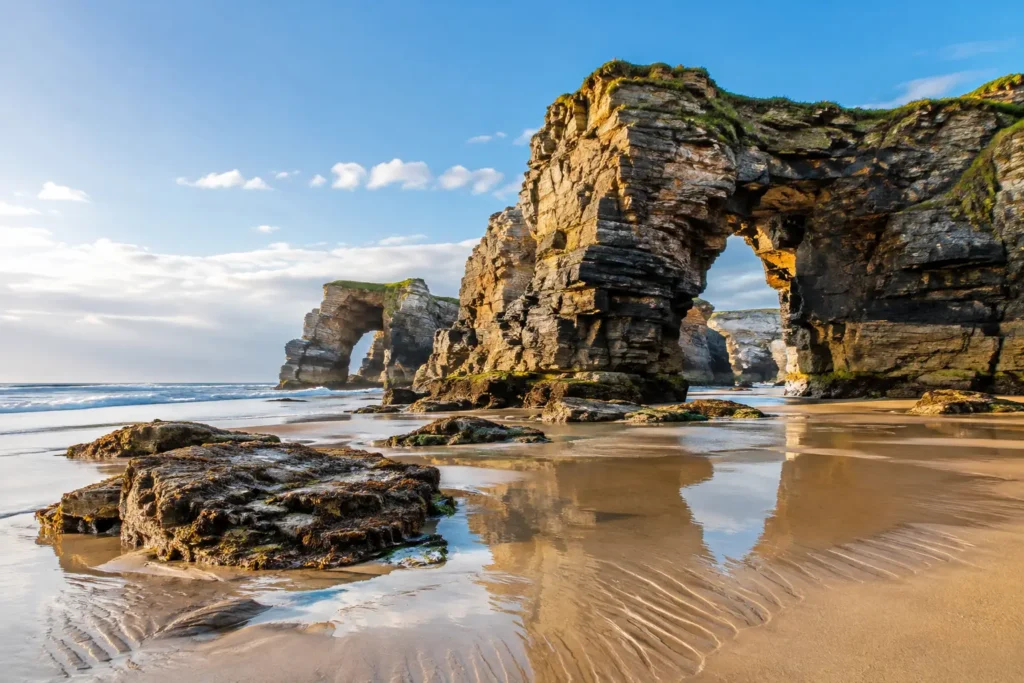
At Playa de las Catedrales, the sea decides what you get to see. This Playa Catedrales tide schedule guide helps you plan for the moment the beach reveals its famous stone arches, caves, and towering rock walls. Arrive at high tide and you will still find a spectacular coastline. Arrive during low tide and you can walk beneath the formations that give this beach its cathedral-like name.
Known in Galician as Praia das Catedrais, this natural monument sits on the northern coast of Lugo province, near Ribadeo. It is one of Galicia’s most requested coastal visits, but it rewards travelers who plan around the tide rather than simply choosing a convenient hour.
Why the tide schedule matters at Playa Catedrales
The beach changes dramatically twice a day. At high tide, the water reaches the base of the cliffs and much of the sand is inaccessible. The arches remain visible from the upper viewpoints, but the walk along the shoreline is not possible.
Low tide opens the main beach and exposes the route between giant rock buttresses, narrow passages, and sea caves. This is when visitors can appreciate the scale of the cliffs from below and see the details carved by the Cantabrian Sea over thousands of years.
That difference is why the low-tide window should be the starting point for your day. Do not plan your visit around lunch reservations, hotel checkout, or a drive from another city until you have checked the tide forecast first. The beach is not an attraction with fixed opening hours. Its most iconic areas are available only when nature allows it.
How to read the Playa Catedrales tide schedule
A tide table usually shows the time and height of high and low tides for a specific day. For a beach walk, focus on the low-tide time, not only on the word “low.” A very low tide generally gives you more exposed sand and a wider area to explore, while a less pronounced low tide may leave some sections narrower or wet.
Tide times shift from one day to the next, often by close to an hour. A low tide that occurs in the morning today may happen around midday tomorrow, then later in the afternoon on the following day. Check the forecast again shortly before your visit, especially if your itinerary was arranged weeks in advance.
For most travelers, arriving around one and a half to two hours before low tide is a sensible approach. You can descend to the beach while there is still room to walk, watch the sea retreat, and explore the formations near the low-tide peak. It also gives you time for photos without rushing through the entire visit.
Do not stay until the water is visibly close. The tide returns quickly in some areas, and narrow sections near the cliffs can become difficult to leave. Pay attention to signs, marked access points, staff instructions, and the behavior of the sea. If you are visiting with children, keep the group together and leave the beach well before the rising tide reduces your exit route.
A simple timing example
If the forecast shows low tide at 12:30 p.m., aim to be at the access area by about 10:30 or 11:00 a.m. This gives you time to park, use the facilities, walk to the beach, and enter without missing the best part of the window. If you are joining a guided day trip, confirm that the itinerary has been designed around that day’s tide rather than a generic schedule.
The ideal arrival time depends on the sea conditions, the height of the tide, and how long you want to photograph or walk. For a relaxed visit, allow at least 90 minutes at the beach itself, plus extra time for viewpoints and the walk back.
Check access reservations before you go
During high-demand dates, access to Playa de las Catedrales may require a free advance reservation. This measure helps protect a fragile coastal landscape that receives many visitors in summer, during Easter week, and on other busy periods.
Reservation requirements can vary by season and by date, so do not assume that a previous visitor’s experience applies to your trip. Check the current access rules before setting out. A reservation, when required, does not replace tide planning. You still need to choose a time that works with the low-tide window.
Bring the confirmation requested for entry and allow time for the walk from parking or the drop-off area. If you are traveling by rental car, arrive earlier on summer weekends and holidays, when traffic and parking can add unexpected delays. Travelers without a car often prefer an organized excursion because transportation and the visit timing are coordinated in advance.
Choose the right visit for your travel style
Independent travelers have the most flexibility if they can adjust their route according to the tide. This works well for visitors staying in Ribadeo or nearby coastal towns, especially if they are comfortable checking conditions and driving on their own.
A guided excursion is often more practical for travelers based in Santiago de Compostela, A Coruña, or other cities farther away. The drive to this part of Galicia is part of a full day, and a local guide can coordinate the timing, explain the coastal landscape, and remove the uncertainty of managing parking and access logistics. Tour Galicia organizes visits with the day’s conditions in mind, so travelers can focus on the experience rather than the route.
For families, the best option is usually a visit centered on a comfortable low-tide period, without trying to combine too many stops. The beach surface can be uneven and slippery, particularly after rain or near pools of water. Sturdy closed-toe shoes are more useful than sandals, even on a sunny day.
Photographers may prefer a low tide that coincides with softer early or late daylight, but this is not always possible. Midday low tide can offer the broadest practical visit window, while early morning and late afternoon can bring more atmospheric light. The trade-off is simple: choose between the most flattering light and the most convenient or spacious beach conditions.
What to bring and how to stay safe
The weather on Galicia’s north coast can change quickly. A clear morning can become windy and cool near the water, so bring a light waterproof layer even in warmer months. Wear shoes with grip, carry water, and protect cameras and phones from sand and spray.
The formations are beautiful because they are natural and exposed. Avoid climbing unstable rock, entering areas that are closed or poorly lit, and walking deep into caves when the tide is turning. Waves can reach farther than expected, particularly during rough sea conditions. The safest photo is never worth ignoring a warning sign.
Leave the beach exactly as you found it. Do not remove shells, stones, or other natural material, and keep to designated paths above the beach. The cliffs and arches are part of a protected landscape, not a set built for tourism.
Make the most of the high-tide hours
High tide does not mean your trip has been wasted. The clifftop viewpoints offer broad views of the coast and a powerful perspective on the arches as waves break against them. This is also a good time for a coffee, a meal in the Ribadeo area, or a stop at another scenic point before returning for the beach walk.
If your schedule allows, seeing Playa de las Catedrales from above at high tide and from below at low tide makes the transformation easier to understand. It is almost two different landscapes in the same day.
Before you leave, check the latest forecast one more time, save your access confirmation if needed, and give the sea the final word on your schedule. That small bit of planning is what turns a visit to Playa de las Catedrales from a quick coastal stop into one of the defining memories of Galicia.
Visit Cathedrals Beach at the right tide
Choose your departure point and book a guided day trip with transport, Lugo and Ribadeo included.