

10 Best Viewpoints in Costa da Morte, Galicia
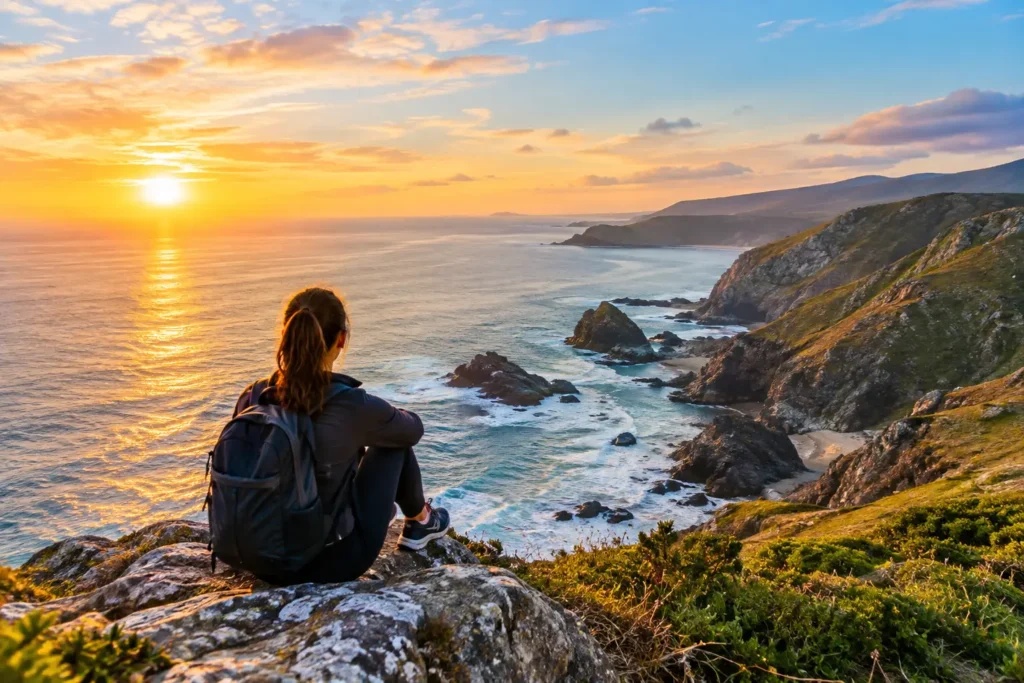
The best viewpoints Costa da Morte are not all at the end of an easy roadside stop. Some sit beside historic lighthouses, others require a short walk over granite paths, and several are at their most memorable when the Atlantic is rough and the sky keeps changing by the minute. This is a coastline to enjoy without rushing: a place where cliffs, beaches, fishing villages, and shipwreck stories share the same horizon.
For a first visit, choosing a few well-placed stops matters more than trying to see every cape. Distances can look short on a map, but the roads curve through villages and along the coast. Here are the viewpoints worth building into a day trip from Santiago de Compostela or A Coruña.
10 best viewpoints in Costa da Morte
1. Cape Fisterra and its lighthouse
Cape Fisterra is the classic final stop on the Atlantic edge of Galicia. Long associated with the end of the Camino de Santiago, its lighthouse stands high above the ocean, with broad views toward open water and the jagged coastline below.
Come late in the day if you can. Sunset is the obvious draw, but the experience depends on the weather: a clear evening gives you color and long views, while mist and wind create the more dramatic atmosphere that many travelers expect from Costa da Morte. In high season, arrive with time to park and walk around rather than trying to stop at the last minute.
2. Mirador de Ézaro
Ézaro offers one of Galicia's most striking combinations of river, mountain, and sea. The viewpoint rises above the mouth of the Xallas River, close to the famous waterfall where the river reaches the Atlantic, and looks over the shoreline toward Mount Pindo.
The road to the upper viewpoint is steep, but access is straightforward by car. The large panoramic platform makes this a practical choice for families and travelers with limited time. Pair it with a stop at the Ézaro waterfall at sea level, especially after rainfall, when the water flow is more impressive.
3. Monte Pindo
Monte Pindo is the choice for travelers who want to earn the view. Often called the Celtic Olympus, this granite massif dominates the landscape around Carnota and Ézaro. From its higher trails, the reward is a wide Atlantic panorama, with the beach and wetlands of Carnota stretching below.
This is not a quick photo stop. Routes vary in length and difficulty, and the terrain can be uneven, exposed, and slippery after rain. Wear proper walking shoes, carry water, and avoid starting late in the afternoon. If you prefer the scenery without a hike, the views from the roads around Ézaro and Carnota still show why this mountain is so distinctive.
4. Carnota Beach and the Monte Louro horizon
At nearly four miles long, Carnota Beach feels less like a single beach and more like a whole coastal landscape. Its dunes and marshes create a broad foreground, while Monte Louro rises in the distance. The best perspective comes from the access points and elevated roads near the northern end, where the full sweep of sand becomes visible.
This is a quieter viewpoint than Cape Fisterra or Ézaro. It suits travelers who want space, a walk by the water, and a chance to see the coast at a slower pace. Morning light is especially good for photography, while sunset can be beautiful when the tide, clouds, and mountain silhouette align.
5. Cape Touriñán
Cape Touriñán is wilder and usually less crowded than Fisterra. It is the westernmost point of mainland Spain, and its lighthouse watches over a coastline shaped by powerful swells and persistent wind. There are no grand urban promenades here, just Atlantic exposure, rugged rock, and the sound of the sea.
Visit when you have time to walk the paths around the headland. On calm days, the view feels expansive and peaceful; on stormy ones, it shows the force behind the name Costa da Morte. Keep well back from cliff edges and never cross barriers for a closer photo. The ocean here deserves respect.
6. Cabo Vilán Lighthouse
Near Camariñas, Cabo Vilán Lighthouse stands on one of the region's most dramatic headlands. The tall white tower rises above dark granite cliffs, with the Atlantic extending in every direction. It is a particularly strong stop for travelers interested in maritime history, as this coast has long been known for difficult navigation and shipwrecks.
The surrounding paths add depth to the visit. Instead of photographing only the lighthouse, walk a little beyond it to see the rock formations and the water breaking below. The landscape is spectacular in bright sun, but cloudy weather often gives it a more authentic, cinematic character.
7. Punta Nariga
Punta Nariga, between Malpica and Camariñas, is a less famous but highly rewarding cape. Its modern lighthouse was designed to resemble the bow of a ship, fitting naturally into the granite surroundings. The road is narrow in places, yet the final approach delivers a feeling of genuine remoteness.
This is a good alternative for travelers who have already visited the better-known lighthouses. There are few distractions, so the viewpoint is about the sea, the rocks, and the changing light. Bring a light jacket even in summer. The wind can be surprisingly strong.
8. Monte Branco and the dunes of Ponteceso
Monte Branco overlooks the estuary of the Anllóns River and one of the most unusual landscapes in Costa da Morte: a vast white dune system framed by river, wetlands, and ocean. From above, the contrast between pale sand, dark green vegetation, and blue water is striking.
The viewpoint is best approached as part of a stop around Ponteceso and the nearby beaches. It is not as immediately dramatic as a cliff-top lighthouse, but it reveals a softer, more ecological side of the coast. Go in the morning or near sunset, when lower light brings out the shapes of the dunes.
9. Muxía and the Sanctuary of Virxe da Barca
Muxía is one of the most emotional places on this coast. The Sanctuary of Virxe da Barca sits beside huge granite rocks at the edge of the sea, where religious tradition, local identity, and maritime landscape meet. The viewpoint is easy to reach from town and works well in most itineraries.
Walk beyond the sanctuary to take in the harbor, the open ocean, and the rounded rock formations. Muxía is especially appealing for travelers who want to combine a scenic stop with time for lunch or a stroll through a working fishing village. After visiting the coast, the compact town center offers a welcome change of pace.
10. Laxe Church viewpoint
Above the town of Laxe, the Church of Santa María da Atalaia provides one of the most accessible elevated views on the coast. From the church area, you can look down across the beach, the bay, and the low peninsula that protects the harbor.
It is a smaller-scale viewpoint, but that is part of its appeal. Laxe gives you the chance to see how coastal life and landscape fit together: boats in the harbor, homes climbing the slope, and a broad sandy beach only steps from town. It is a smart stop for a coffee, a seafood lunch, or a relaxed break between larger capes.
How to plan a viewpoint route without rushing
A full Costa da Morte route can easily become too ambitious. Fisterra, Muxía, Ézaro, Carnota, Cabo Vilán, and Laxe are all worth seeing, but fitting them into one self-drive day means spending much of the trip on the road. For most visitors, it is better to choose either the southern section around Carnota, Ézaro, and Fisterra, or the northern section around Laxe, Camariñas, Cabo Vilán, and Muxía.
Weather should shape your plans. Clear days favor long-distance panoramas, while cloudy or windy conditions can make lighthouse stops more dramatic. Fog can also arrive quickly, particularly near the capes. Check the forecast, but do not cancel a coastal day simply because there are clouds. On Costa da Morte, changing weather is often part of the experience.
If you are not renting a car, a guided day trip is the easiest way to see several major viewpoints without worrying about mountain roads, parking, or timing. Tour Galicia organizes excursions with local guides who can give context to the places that might otherwise feel like just another beautiful stop on a map.
Bring a windproof layer, comfortable shoes, water, and a charged phone or camera. Most importantly, leave room in the itinerary for an unplanned pause. The best moment may be a sudden break in the clouds over Cape Touriñán, the tide reaching Carnota Beach, or a fishing boat returning to Muxía harbor - the kind of view that is better enjoyed with time to stand still.
See Costa da Morte with a local guide
Visit Fisterra, Muxía, Ézaro and other Atlantic landmarks on a full-day tour from Santiago de Compostela.