

How to Reach Catedrales Beach From Galicia
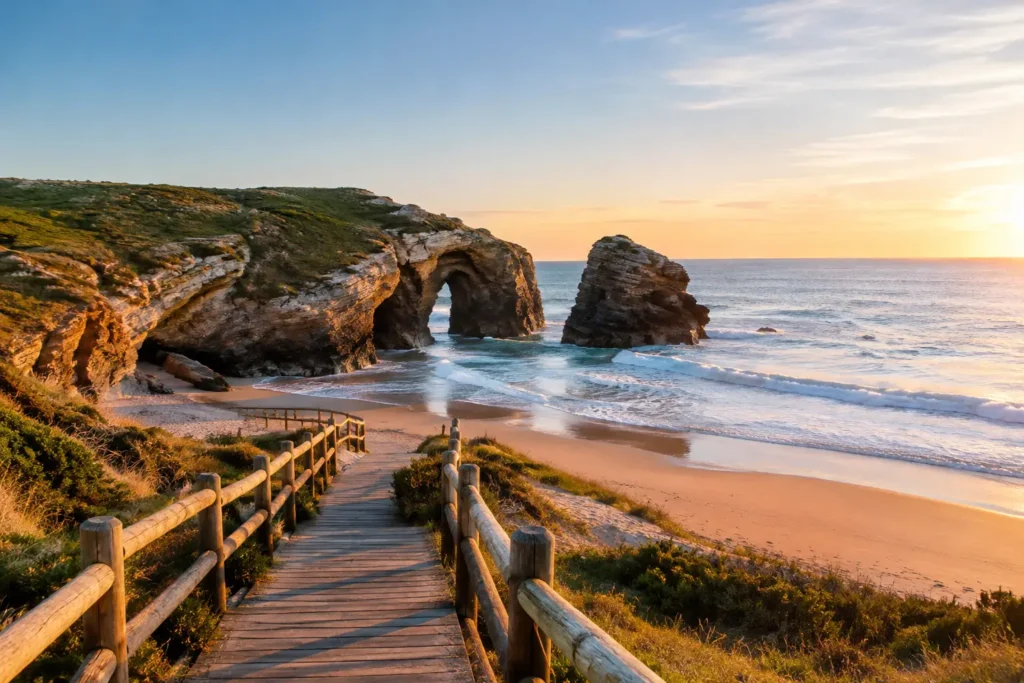
The first view of Catedrales Beach can be misleading: from the clifftop, it looks like a beautiful stretch of Cantabrian coast. At low tide, however, the sea retreats to reveal its famous stone arches, caves, and narrow passages carved into the rock. Knowing how to reach Catedrales beach is only part of the plan. To experience the beach at its best, you also need to arrive at the right time.
Located on Galicia’s northern coast, near Ribadeo in the province of Lugo, Praia das Catedrais is one of the region’s most striking natural landmarks. It is reachable independently by car and public transportation, but a guided day trip is often the easiest option for travelers staying in Santiago de Compostela or A Coruña who prefer to leave the logistics to someone who knows the route.
Where is Catedrales Beach?
Catedrales Beach, officially Praia de Augas Santas, lies about 6 miles west of Ribadeo, close to the border between Galicia and Asturias. Its name, which translates as Beach of the Cathedrals, comes from the soaring rock formations that resemble Gothic arches.
The beach is part of the As Catedrais Natural Monument. That protected status helps preserve the landscape, but it also means access may be regulated during busy periods. Before setting out, check the official access rules and the tide forecast for your planned date.
How to reach Catedrales Beach by car
Driving gives you the most flexibility, especially if you are combining the beach with Ribadeo, the nearby coastal villages, or western Asturias. From Ribadeo, follow the N-634 west toward the beach. The drive usually takes around 10 to 15 minutes, depending on traffic and the parking area assigned for the day.
From Santiago de Compostela, allow roughly two and a half to three hours each way. The most direct route generally uses the AP-9 toward A Coruña, then connects with roads toward Lugo and the A-8. From A Coruña, the journey is usually around one hour and 45 minutes to two hours. Travel times can change with weather, roadworks, and summer traffic, so it is wise to leave extra time.
There is parking near the beach, but it fills quickly in high season and on weekends. Follow local signs rather than relying only on an app, as traffic management and available lots can change. Once parked, there is a short walk to the clifftop viewpoint and access path.
What to know before driving
A car is ideal if you want to travel at your own pace, but it does not solve the most important timing issue: the tide. Arriving at noon is no guarantee that you can walk among the arches. The beach is only fully accessible around low tide, and the exact time changes every day.
If your visit falls during a period when a free visitor permit is required, arrange it in advance. These controls are commonly used during peak dates, including much of the summer season and certain holiday periods. A parking space does not replace a beach access permit.
Reaching Catedrales Beach from Ribadeo
Ribadeo is the most convenient base for independent visitors without a car. The town has a pleasant historic center, a harbor, restaurants, and accommodations, making it a practical place to stay before or after a beach visit.
From Ribadeo, a taxi is the simplest choice if you are traveling with family, carrying beach gear, or working around a specific low-tide window. Local bus connections may operate seasonally or on limited schedules, so they require more planning. Confirm the current timetable before you depend on a bus for your return journey.
You can also walk or cycle from Ribadeo, although it is a substantial distance for a casual beach outing. It works best for experienced cyclists or travelers building the visit into a longer coastal route. Keep in mind that the return may happen after a long walk on sand and uneven rock.
Can you take the train to Catedrales Beach?
Train travel can bring you to Ribadeo or nearby stations on the narrow-gauge rail network, but it is rarely the fastest way to reach the beach from major Galician cities. Services can be less frequent than visitors expect, and you will still need to organize transport from the station to the coastline.
For travelers coming from Asturias, the regional rail route can be scenic and useful if schedules line up. From Santiago or A Coruña, rail usually involves longer connections than driving or joining an organized excursion. It can be a good choice for slow travel, but not for a tightly timed low-tide visit.
The key is to avoid treating the train as a direct beach service. Check the arrival time in Ribadeo, the onward transfer options, and, most importantly, whether you can reach the sand during the low-tide window.
The easiest option from Santiago or A Coruña
For many visitors, a guided day trip is the most comfortable answer to how to reach Catedrales beach from Santiago de Compostela or A Coruña. The distance is considerable, the tide cannot be ignored, and public transportation connections can make an independent day trip feel rushed.
An organized excursion brings together transportation, a planned itinerary, and guidance from a local professional. It also allows you to enjoy the northern Galician landscapes rather than monitor directions, parking, and return schedules. Depending on the route, you may have time to discover Ribadeo and other highlights along the coast as well.
This option is especially useful for couples, families, and international travelers who do not plan to rent a car. Tour Galicia designs day trips around practical timing and local knowledge, so visitors can focus on the experience with someone who knows the region. When comparing tours, confirm the departure city, duration, included stops, and cancellation conditions before booking.
Plan your visit around low tide
The arches are the reason most people come, and they are visible from the beach only at low tide. At high tide, the sea covers much of the sand and can block access to the caves and rock corridors entirely. The view from above is still worthwhile, but it is a very different visit.
Aim to arrive well before low tide, rather than exactly at the published time. This gives you time to park, walk to the access point, and descend to the sand without rushing. The safest and most rewarding period is usually the hours around low tide, but conditions vary with sea state and official safety guidance.
Do not enter closed areas, climb the cliffs, or walk into caves if the tide is rising. The Cantabrian Sea changes quickly, and the dramatic scenery is not a place to take unnecessary risks. Follow signs and instructions from local staff at all times.
Access permits and practical tips
Access to the beach itself is free, but a prior reservation may be mandatory on selected dates to protect the natural site. The permit is normally free of charge, yet availability can run out during summer and holiday weekends. Check whether your date is regulated before you travel, even if you are arriving on a tour.
Wear shoes with good grip. Sand, wet stone, and pools left by the tide can be slippery, while flip-flops are not ideal for exploring the arches. Bring a light waterproof layer too. Northern Galicia can change from sunshine to wind and rain quickly, even in summer.
There are facilities near the upper access area, but the beach itself is a natural setting, not an urban promenade. Bring water, protect your phone from sand and moisture, and take all waste with you. If you are visiting with children or guests with limited mobility, enjoy the panoramic viewpoints as well: the descent and beach surface may not suit everyone.
Catedrales Beach rewards travelers who plan for nature rather than trying to fit it into a fixed schedule. Choose a low-tide day, reserve access if required, and give yourself enough time to stand beneath the arches without watching the clock.