

Top Historic Sites Around Lugo Worth Your Time
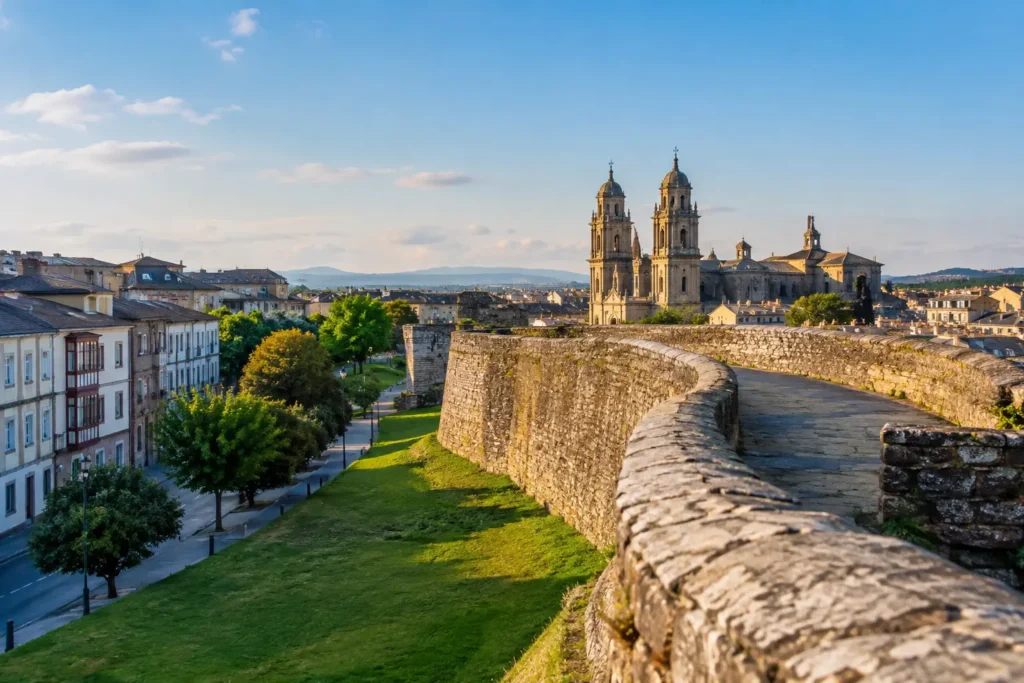
Lugo is one of those places where history is not kept behind a museum door. It follows the line of the city, appears beneath modern streets, and continues into the green countryside a few miles beyond the center. The top historic sites around Lugo reward travelers who give themselves time to look beyond a quick photo of the Roman Wall.
For a first visit, combine the compact old town with one or two nearby landmarks. The city is easy to explore on foot, while the rural sites require a car, a taxi, or an organized excursion. That small amount of planning makes a major difference, especially if you are traveling from Santiago de Compostela, A Coruña, or Ribadeo and have just one day in Lugo.
Top historic sites around Lugo: start inside the walls
The Roman Wall of Lugo
Lugo's Roman Wall is the essential place to begin. Built between the late 3rd and early 4th centuries AD, it encircles the historic center for more than 1.2 miles and remains remarkably complete. This is not a fragment to admire from behind a barrier. You can climb up and walk its broad rampart, seeing towers, gates, roofs, and the city beyond.
Allow at least 45 minutes for the walk, or longer if you want to stop for photographs. The circuit is mostly level, which makes it one of the most accessible ways to understand the scale of Roman Lucus Augusti. The wall is especially enjoyable in the early morning or toward evening, when the light softens and the old town is quieter.
Do not limit your visit to the top. Walk outside the wall near the gates to appreciate its height, then return through one of the entrances into the historic center. The contrast between ancient stonework and everyday city life is precisely what makes Lugo distinctive.
Lugo Cathedral and its medieval layers
Inside the walls, Lugo Cathedral brings a different era into focus. Its origins go back to the 12th century, but the building has accumulated Romanesque, Gothic, Baroque, and Neoclassical details over the centuries. The main facade is an impressive introduction, yet the interior is where the cathedral's long life becomes clearer.
Look for the Romanesque elements and the calmer atmosphere of the chapels and cloister. The cathedral is also known for its continuous display of the Blessed Sacrament, a tradition that gives it a particular place in Galicia's religious heritage.
This is a site best appreciated with context. A local guide can point out which parts belong to the medieval church and which are later additions, saving you from treating a complex building as a simple photo stop. Dress respectfully, and remember that visiting hours can be affected by services and religious celebrations.
Domus do Mitreo
Near the cathedral, the Domus do Mitreo reveals Roman Lugo at a more intimate scale. The archaeological site preserves remains of a wealthy Roman house, including traces connected with the cult of Mithras, a mystery religion practiced across the Roman Empire.
The interpretation center explains what archaeologists found beneath the city and why it matters. It is not a vast ruin, so it works well as a focused stop of around 30 to 45 minutes. For travelers who enjoy archaeology, it adds depth to the wall: Lugo was not only fortified, but also a working provincial city with homes, beliefs, and social life.
The Roman Baths and the Miño riverfront
At the edge of the old town, the Roman Baths offer another useful perspective on daily life in Lucus Augusti. The remains are associated with the historic spa area near the Miño River, where thermal waters have attracted visitors since Roman times.
The setting matters as much as the ruins themselves. After a walk through the old center, head toward the river and notice how the landscape changes from stone streets to wooded banks. The nearby Roman Bridge, rebuilt and altered over time, is a pleasant point from which to take in the river corridor. It is a quieter part of Lugo, ideal if you want history with a break from the busiest streets.
Historic places near Lugo for a half-day outing
Santa Eulalia de Bóveda
About 10 miles from Lugo, Santa Eulalia de Bóveda is one of Galicia's most intriguing early historic monuments. From outside, it can seem modest. Inside, however, its unusual structure, painted decoration, and archaeological mysteries make it unlike any standard country church.
The building may have served a late Roman religious or funerary purpose before later Christian use, though scholars continue to debate aspects of its original function. That uncertainty is part of the appeal. Rather than presenting a neatly resolved story, Santa Eulalia de Bóveda shows how much remains to be interpreted about the transition from Roman rule to the early medieval world.
Because the site is small, pair it with Lugo city or another nearby stop. Check opening times before setting out, as access can be more limited than at the major attractions in the center.
Castro de Viladonga
For an older chapter of northwestern Iberia, drive about 15 miles northeast of Lugo to Castro de Viladonga. This hillfort was occupied during the late Iron Age and into the Roman period, and its excavated remains make the layout of a castro easy to understand.
You can see the defensive lines, streets, and foundations of circular and rectangular structures spread across the hilltop. The on-site museum gives valuable context through pottery, tools, ornaments, and other finds from daily life. It is an excellent choice for families and for travelers curious about the people who lived in Galicia before and during Romanization.
Plan roughly 90 minutes to two hours here, including the museum. Conditions can be exposed in wet or windy weather, so bring suitable footwear and a light layer. The site is more rewarding when you slow down and picture a settlement rather than expecting monumental stone buildings.
Pazo de San Marcos and the Provincial Museum
Back in Lugo, the Provincial Museum is housed in the former convent of San Francisco, close to the old town. It is a strong option for a rainy afternoon or for anyone who wants to connect the region's major periods in one visit.
Its collections include Roman inscriptions and mosaics, medieval religious art, traditional Galician objects, and pieces that help explain rural life across the province. The building itself deserves attention, particularly the cloister. While it is not an outdoor archaeological site, it provides the historical framework that makes the wall, cathedral, and hillfort more meaningful.
How to organize a visit without rushing
If you have only a few hours, walk the Roman Wall, visit the cathedral, and choose either Domus do Mitreo or the Provincial Museum. This route keeps everything within the walled center and gives a satisfying introduction to Lugo's Roman and medieval identity.
With a full day, add Santa Eulalia de Bóveda or Castro de Viladonga. Choosing between them depends on your interests. Bóveda suits travelers fascinated by rare sacred architecture and archaeological mysteries. Viladonga is the better choice if you want open landscapes, a substantial hillfort, and a clearer look at pre-Roman and Roman-era settlement.
Independent drivers have the most flexibility outside the city, but parking and unfamiliar rural roads can take time away from the visit. A guided route is often more comfortable for travelers who prefer not to manage transport, schedules, and historical interpretation themselves. With Tour Galicia, visitors can experience Lugo with local guides who turn dates, stones, and legends into a story that makes sense on the ground.
Wear comfortable shoes even for a city-only plan. Lugo's historic center has stone pavement, and the wall involves stairs at access points. Keep a little room in your schedule for lunch as well: the old town is a good place to enjoy Galician cooking after a morning of sightseeing, rather than trying to rush through every landmark.
The best visit to Lugo is not the one that checks off the most monuments. It is the one that leaves you standing on the Roman Wall, looking over a living Galician city, with enough time to understand why those stones are still part of everyday life.