

How to Visit Finisterre Car Free from Santiago
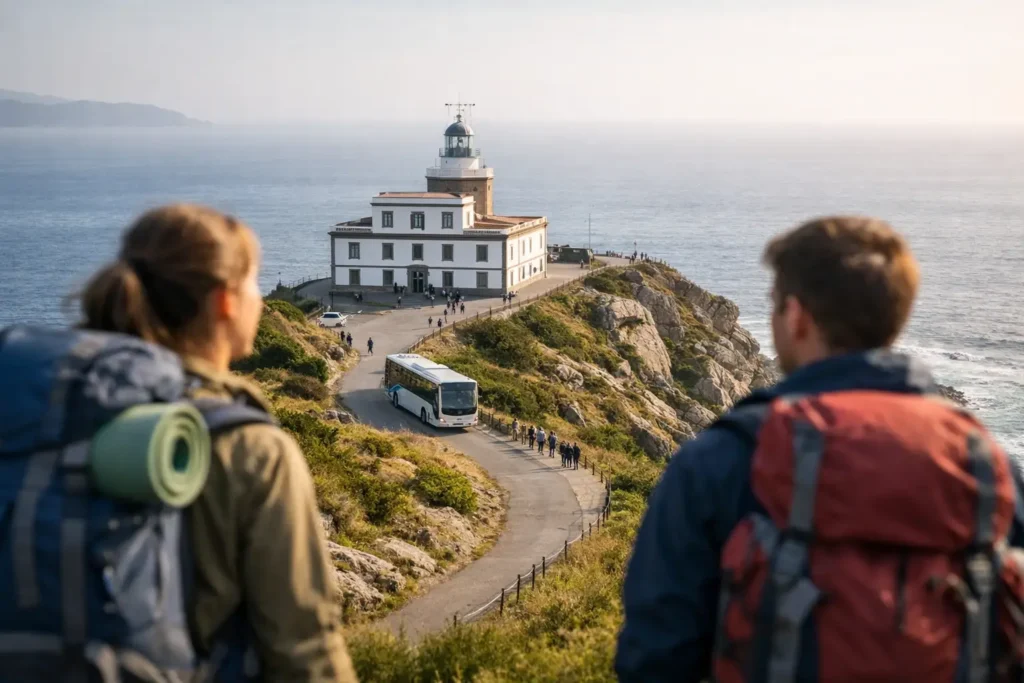
The road west from Santiago de Compostela ends in a landscape that feels bigger than a map: granite cliffs, white surf, fishing villages, and the lighthouse at Cape Fisterra. If you are wondering how to visit Finisterre car free, the good news is that it is entirely possible. The more useful question is how much time you have and whether you want the journey to be simple or fully independent.
For most visitors staying in Santiago, an organized day trip is the easiest way to see Finisterre and the Costa da Morte without losing hours to connections. Public buses can work well for travelers who want to spend a night in town or travel at a slower pace. Both options let you experience one of Galicia’s most memorable coastlines without renting a car.
Why Finisterre is worth the trip
Finisterre, also known by its Galician name, Fisterra, lies on the Atlantic coast around 55 miles west of Santiago. Its name comes from the Latin expression for “end of the earth.” Romans believed this was the western limit of the known world, and after walking the Camino de Santiago, many pilgrims still continue here to reach the ocean.
The destination is not only the cape. The drive through the Costa da Morte reveals a different side of Galicia: the medieval stone of Muros, the broad curve of Carnota Beach, the falls at Ézaro, the port of Finisterre, and the lighthouse overlooking the Atlantic. Reaching only the village and returning immediately is possible, but it misses much of what makes the route special.
That is why car-free travel requires a little planning. Public transportation is designed primarily for local travel, not for sightseeing stops. A guided excursion, by contrast, turns the route itself into part of the experience.
How to visit Finisterre car free: choose your route
Your best option depends on your starting point, your available time, and the kind of day you want. Santiago de Compostela is by far the most practical base. From A Coruña, the journey is possible but generally takes longer and may involve a connection. Visitors arriving on a cruise should pay close attention to port schedules and choose an excursion designed around their time ashore.
Take a guided day trip from Santiago
A guided full-day excursion is the most comfortable answer for travelers who want to see Finisterre efficiently. Transportation is coordinated, the route includes the major coastal sights, and you return to Santiago the same day without worrying about the last bus or navigating unfamiliar rural roads.
This option is particularly useful if you have only a few days in Galicia. You can visit Cape Fisterra, learn why the Costa da Morte earned its dramatic name, and stop in villages and viewpoints that are difficult to reach independently. A local guide adds context that is easy to miss on your own, from Camino traditions to the working rhythms of fishing ports and shellfish beds.
Tour Galicia offers organized excursions from Santiago for travelers who want to discover the coast with local guides and a clear itinerary. This is a strong choice for couples, families, and independent travelers who prefer to reserve one experience rather than coordinate several transportation details.
The trade-off is flexibility. You will follow a set schedule and share the day with other travelers. For many visitors, that structure is a benefit: the route is already timed to make the most of daylight and avoid the stress of getting stranded far from Santiago.
Travel by public bus
Public buses connect Santiago de Compostela with Finisterre, usually via services toward the Costa da Morte. This can be the right option if Finisterre is your destination rather than one stop on a larger sightseeing route.
Before committing to this plan, check the current timetable carefully. Frequency can vary by day of the week and season, and not every service is convenient for a same-day visit. A route that looks short on a map may leave you with limited time at the cape, particularly if you need to travel from the town center to the lighthouse.
The bus generally arrives in or near the town of Finisterre, while Cape Fisterra and its lighthouse are a few miles farther west. You may be able to walk, take a taxi, or use local transportation depending on the season and availability. The walk is scenic but not a quick stroll, so allow time and be prepared for changing weather.
For a relaxed car-free trip, consider staying overnight in Finisterre. You can arrive in the afternoon, walk around the harbor, enjoy fresh seafood, and visit the lighthouse around sunset or the following morning. This turns a tight day trip into a more atmospheric coastal stay.
Combine buses with a local taxi
Travelers who prefer independence but do not want a long walk can take the bus to Finisterre town and arrange a taxi for the lighthouse or nearby beaches. This approach gives you more freedom than a group excursion, but it comes with a practical warning: taxis are not as abundant as they are in Santiago.
If you plan to use one, ask your accommodation, restaurant, or local tourism office to help arrange it. Do not assume a car will be waiting at the lighthouse when you are ready to return. Booking both directions, or agreeing on a pickup time, is the safer plan.
Plan enough time for the cape
The lighthouse at Cape Fisterra is the emotional high point of the visit. On a clear day, the ocean seems to stretch without end. On a foggy or stormy day, the place can feel even more powerful, with waves breaking against dark rock and wind moving across the headland.
Give yourself at least 45 minutes there, longer if you enjoy photography or want to walk the marked paths. The terrain is exposed, so bring a windproof layer even in summer. Galicia’s weather changes quickly, and the coast is often cooler than Santiago.
It is also worth knowing that the cape is not a place for the old Camino ritual of burning boots or clothing. That practice is unsafe and prohibited. Leave the landscape exactly as you found it, take your photos, and enjoy the meaning of arriving at the Atlantic without adding to the area’s fire risk.
What you can see without a car
A guided route allows you to experience several Costa da Morte highlights in one day. Depending on the itinerary and season, these can include Muros, Carnota Beach and its famous hórreo, the Ézaro Waterfall, Finisterre village, and Cape Fisterra.
Independent bus travel is best suited to Finisterre town and the lighthouse. Adding Carnota, Ézaro, or small villages such as Muxía becomes more complicated because connections are less frequent. It can be done over multiple days, but it requires patience, advance timetable checks, and sometimes taxis.
That distinction matters when booking accommodations. If Finisterre is your priority, take the bus and spend the night. If you want the full coastline in one day, a professionally organized excursion is generally better value in time and effort.
Practical advice for a comfortable day
Start with your return journey, not your outbound journey. Whether you are using a bus or taxi, confirm how and when you will get back before you leave Santiago or Finisterre town. Mobile signal can be uneven around exposed coastal areas, and a missed final service can turn a beautiful day into an expensive problem.
Wear comfortable shoes with grip, especially if you intend to walk around the cape. Bring water, a light snack, sunglasses, and a rain layer. Restaurants and cafés are available in Finisterre town, but options near the lighthouse are more limited. During high season, reserve accommodations in advance if you plan to sleep there.
If you are visiting after completing the Camino, consider whether you want a ceremonial final evening at the coast. An overnight stay gives the moment more space. If your Galicia itinerary is packed, a day trip from Santiago lets you enjoy the same dramatic destination and return to the city for dinner.
Finisterre is not hard to reach without a car, but it rewards travelers who choose the right pace. Leave room for the road, the weather, and the views. The Atlantic will do the rest.