

7 Best Ribeira Sacra Villages Worth Your Time
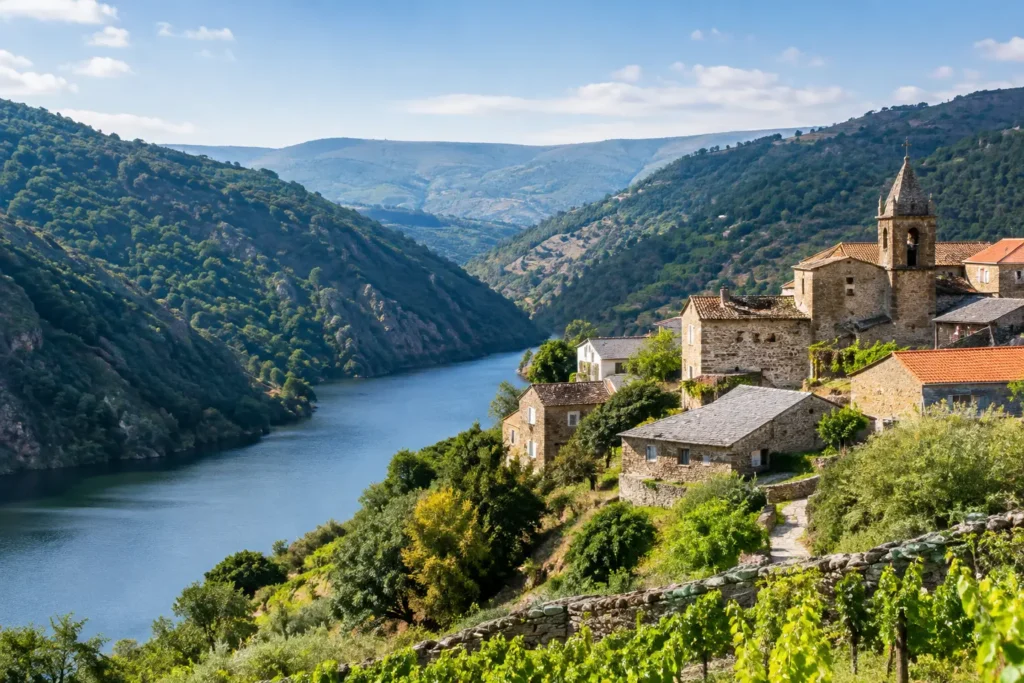
The best Ribeira Sacra villages are not places to rush through between viewpoints. They are the quiet centers of a landscape shaped by the Sil and Miño rivers, where vineyards climb improbably steep slopes, Romanesque churches appear beyond a bend, and lunch can easily become the highlight of the day. Choosing the right stops makes a real difference, especially if you have one day and want to enjoy the region without spending it entirely behind the wheel.
Ribeira Sacra is spread across inland Galicia, mainly between the provinces of Lugo and Ourense. Its beauty lies partly in that scale: there is no single town that represents the whole destination. The best route combines a village or two with a river cruise, a panoramic viewpoint, and time to taste the local wines. Here are seven places that deserve a spot on your itinerary.
1. Parada de Sil
Parada de Sil is one of the most rewarding bases for travelers drawn to dramatic scenery. Perched above the Sil Canyon in the Ourense side of Ribeira Sacra, this small village is close to some of the area’s most memorable viewpoints and walking routes.
Its essential stop is the Monastery of Santa Cristina de Ribas de Sil, a remarkably atmospheric Romanesque complex surrounded by chestnut woods. The approach alone sets the tone: this is a place where the architecture feels inseparable from the forest and valley around it. From Parada de Sil, it is also easy to reach the Balcones de Madrid viewpoint, where wide views open over terraced vineyards and the river far below.
This is an excellent choice for travelers who prioritize landscapes and heritage. The trade-off is that roads in this area are narrow and winding, so it is better suited to a relaxed day than an ambitious itinerary with many distant stops.
2. Castro Caldelas
Castro Caldelas stands out because it offers something many Ribeira Sacra villages do not: a striking medieval castle rising above a compact historic center. Its stone streets, traditional houses, and hilltop position make it one of the region’s most photogenic cultural stops.
The Castle of Castro Caldelas is the main attraction, with views across the valley and exhibitions that help place the village within the history of this inland territory. After visiting, take time to wander rather than simply checking the castle off your list. A coffee on a terrace or a slow stroll through the old quarter reveals the unhurried rhythm that defines much of Ribeira Sacra.
Castro Caldelas works especially well for visitors who want history alongside scenery. It is also a practical stop on routes connecting the Sil Canyon with the interior of Ourense province.
3. Doade
Doade is small, but its location makes it one of the best Ribeira Sacra villages for wine lovers. Set in the municipality of Sober, it sits close to the Sil Canyon and the famous heroic viticulture landscapes, where grapevines are cultivated on terraces so steep that much of the work still requires manual labor.
This is the place to slow down and understand what Ribeira Sacra wine means. The region is particularly known for Mencía reds, which are often fresh, expressive, and shaped by slate, granite, and the local microclimate. Several wineries are found nearby, and tasting wine here has a different dimension when you can see the terraces that produced it.
Doade is also convenient for combining a winery visit with a boat trip on the Sil. If your time is limited, this pairing gives you a clear sense of the region’s defining landscape without trying to cover every corner of Ribeira Sacra.
4. Belesar
Belesar sits beside the Miño River, where the landscape feels gentler than the vertiginous Sil Canyon but no less beautiful. The village is divided between the municipalities of Chantada and O Saviñao, connected by a bridge and surrounded by vines that descend toward the water.
This is a particularly appealing stop for travelers who want a riverside atmosphere. The old paths and vineyard terraces recall the area’s long agricultural history, while the river gives the village a calm, almost hidden quality. Belesar is also associated with the Roman road that once crossed this area, adding another layer to its story.
Choose Belesar if you prefer a quieter, more rural side of Ribeira Sacra. It is less about major monuments and more about taking in the vineyard scenery, enjoying a local meal, and appreciating the relationship between the river and the land.
5. Sober
Sober is larger and more functional than some of the hamlets on this list, which makes it a useful stop for travelers organizing a day in Ribeira Sacra. It is a local center with services, restaurants, and easy access to wineries, viewpoints, and the Sil Canyon.
Its identity is closely connected to wine. In late summer and early fall, the grape harvest brings particular energy to the surrounding countryside, although every season has its appeal. Spring brings green terraces and flowing rivers, while fall offers vineyard colors and cooler conditions for sightseeing.
Sober is a sensible choice if you are staying overnight or want a practical base without giving up local character. It may not have the instant visual impact of Castro Caldelas or Parada de Sil, but its central position can make an itinerary far more comfortable.
6. A Teixeira
A Teixeira is a tiny mountain village with a big advantage: it places you near some of the finest Sil Canyon scenery. The village itself is peaceful and traditional, with stone houses and a rural setting that feels far removed from Galicia’s larger cities.
Travelers often use this area to reach viewpoints such as the Mirador de A Teixeira and nearby routes overlooking the river. The views are broad, layered, and especially impressive in soft morning or late-afternoon light. Bring comfortable shoes, as even short walks can involve uneven ground or slopes.
A Teixeira is best for visitors who enjoy nature and do not need a packed program of museums or shops. It is a place to pause, look out over the canyon, and understand why Ribeira Sacra is one of Galicia’s most distinctive landscapes.
7. Monforte de Lemos
Monforte de Lemos is technically a town rather than a village, but leaving it out would make planning a Ribeira Sacra visit harder. It is one of the region’s main gateways, with more accommodation, restaurants, rail connections, and services than the smaller settlements scattered through the valleys.
Its historic quarter, the San Vicente do Pino complex, and the riverside area offer worthwhile reasons to visit in their own right. More importantly, Monforte is a convenient starting point for reaching wineries, boat docks, and villages on both the Sil and Miño sides of the region.
For independent travelers, Monforte can make logistics easier. For those visiting from Santiago de Compostela without a rental car, an organized Ribeira Sacra day trip can be the more comfortable option, combining transport and local insight while leaving you free to enjoy the views.
How to Choose Which Villages to Visit
If you have only one day, do not try to see all seven. Ribeira Sacra rewards a slower pace, and the roads are part of the experience but also part of the timing. A well-balanced first visit might combine Monforte de Lemos or Sober as a starting point, Doade for wine country, a Sil River cruise, and Parada de Sil or A Teixeira for a viewpoint.
Choose Castro Caldelas if medieval heritage matters most. Pick Belesar for a quieter Miño River setting. Make Parada de Sil your priority for monastery visits and canyon views. The best option depends on whether you are traveling for wine, history, photography, or simply a day in Galicia’s countryside.
Weather also matters. Mist can make the canyons look mysterious, but it can hide the panoramic views visitors hope to see. Wear layers, carry water, and allow extra time for curves and short stops along the road. This is not a destination built for rushing.
The most memorable Ribeira Sacra day is often the one with room for an unplanned stop: a vineyard above the river, a village bakery, or a viewpoint that makes you stay five minutes longer than planned. Travel with someone who knows the area, or leave enough space in your schedule to let the landscape set the pace.