

Can Cruise Guests Visit Santiago from Vigo?
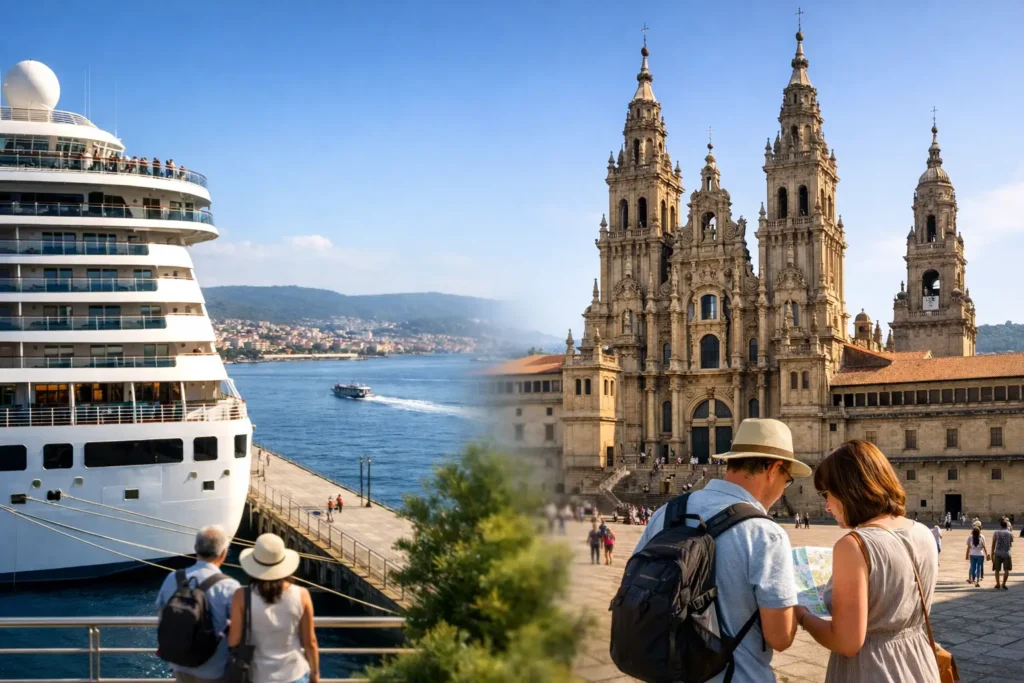
A ship docked in Vigo or A Coruña puts you within reach of one of Spain’s most meaningful cities: Santiago de Compostela. But can cruise guests visit Santiago and still return to the port with time to spare? Yes, in many cases - provided the itinerary is built around your actual docking hours, not just a map distance.
Santiago is not a quick walk from either cruise terminal. It is a destination for a planned shore excursion, with transport, meeting times, and a sensible return buffer. For guests who want to see the Cathedral, walk the old town, and enjoy the atmosphere of the Camino’s final destination, the journey can be one of the highlights of a Galicia cruise call.
Can cruise guests visit Santiago from Vigo or A Coruña?
Both ports can work well, although the experience is slightly different depending on where your ship calls and how long it stays in port.
From Vigo, Santiago de Compostela is usually around 1 hour and 15 minutes by road in normal traffic. From A Coruña, the drive is generally about 1 hour. These are realistic transfer estimates, not a promise that every day will run exactly to the minute. Traffic, local events, weather, and the location of your ship’s berth can all affect the schedule.
That is why a Santiago shore excursion is most suitable for cruise guests with a reasonably long port call. A stay of around eight hours or more normally gives enough room for round-trip transportation, a guided walk, free time, and a calm return to the ship. Shorter calls may still be possible, especially from A Coruña, but they need a more carefully tailored plan.
The key is not to try to fit every corner of Santiago into one visit. Focus on the historic center and you will have time to experience what makes the city special.
What makes Santiago worth the journey?
Santiago de Compostela is much more than the finish line of the Camino de Santiago. Its UNESCO-listed old town is a compact maze of granite streets, arcades, convents, lively squares, and traditional restaurants. For cruise travelers, it offers a strong contrast to the Atlantic ports: less maritime, more historic, and deeply connected to Galicia’s cultural identity.
The Cathedral is the natural centerpiece. Pilgrims have arrived here for centuries, and even visitors who are not walking the Camino can feel the significance of Praza do Obradoiro, the grand square facing the cathedral’s western façade. It is an ideal place for photos and for taking in the scale of the city.
A guided route through the historic center often includes the exterior of the Cathedral, Praza das Praterías, Praza da Quintana, the Cathedral surroundings, and the streets where pilgrims traditionally enter the old town. Depending on the day and available time, you may also have time to browse small shops, try a coffee with a slice of Santiago almond cake, or sit down for an early Galician lunch.
For many guests, the real value is context. A local guide can explain the pilgrimage tradition, the legends of Saint James, the role of the university, and the details hidden in stone façades that are easy to miss on a quick independent visit.
How much time do you need for a Santiago shore excursion?
For a satisfying visit, plan on roughly six to seven hours from port to port. This allows for two to two and a half hours of total road time, depending on the departure port, plus around three hours in Santiago. It is a comfortable format for seeing the principal areas without turning the day into a race.
A shorter visit of about five hours can work from A Coruña if your ship schedule is favorable and the tour is designed specifically for cruise timing. In this case, expect a focused walk through the old town rather than museum visits, a long lunch, or extensive free time.
Guests with nine or ten hours ashore have more flexibility. They may be able to add a longer break in Santiago or make a stop at a viewpoint or another nearby location. Still, more stops are not always better. Santiago deserves enough unhurried time to walk its historic streets and understand why it has drawn travelers for over a thousand years.
The return-to-ship buffer matters
A reliable shore day always includes time reserved for the return journey. Cruise guests should not plan to arrive at the port at the exact all-aboard time. Ships follow strict schedules, and the practical goal is to be back near the terminal well before boarding closes.
When choosing a tour, confirm that it is created for your specific port and ship schedule. Ask about departure location, expected return time, group size, and what happens if traffic delays the route. A cruise-oriented operator should organize the day around these details from the start.
Guided tour, private transfer, or independent visit?
There is no single best option for every traveler. The right choice depends on your group, budget, confidence traveling independently, and the length of your call.
A shared guided excursion is a practical choice for couples, solo travelers, and small groups who want transportation and a guide without arranging a private vehicle. It typically follows a fixed timetable and offers the reassurance of traveling with other cruise guests. The trade-off is less flexibility over the pace and stops.
A private tour is especially useful for families, larger groups, or travelers who want a customized day. You can adapt the pickup time, spend longer at the Cathedral, include a particular restaurant, or adjust the walking pace. It costs more, but the added control can be valuable when time ashore is limited.
Going independently is possible, but it requires more attention. Renting a car means navigating unfamiliar roads, arranging parking outside or near the historic center, and monitoring the clock throughout the day. Public transportation can be less suitable for a cruise call because schedules and station transfers may not align neatly with your ship’s berth. Independent travel can save money, but it leaves you responsible for the return plan.
For most cruise guests, organized transportation offers the simplest balance: a clear meeting point at or near the port, a guide who knows the route, and a schedule built to make the most of the call.
What to wear and bring
Santiago’s old town is best explored on foot, and the streets can be uneven, polished by rain, and occasionally slippery. Comfortable shoes with good grip are more useful than formal footwear. Galicia’s weather can change quickly, even during warmer months, so a light waterproof layer is a smart addition to your day bag.
Bring your ship card, identification required by your cruise line, water, and a small amount of local currency or a payment card for personal purchases. If you hope to enter the Cathedral or attend a religious service, dress respectfully and remember that access arrangements can change due to worship, security, restoration work, or special events.
Guests with reduced mobility should check the walking route before booking. Santiago’s core is compact, but it includes slopes, cobblestones, and steps in some areas. A good provider can explain what the route involves and recommend an option suited to your needs.
How to choose a cruise-friendly Santiago excursion
The best tour is not simply the one that promises the most sights. Look for an itinerary that clearly states its duration, port departure point, return estimate, and the time spent in Santiago. A vague description can be a warning sign when your ship’s schedule is non-negotiable.
It also helps to choose guides who know Galicia and Santiago beyond the standard photo stops. The city’s story is richer when you understand how the Camino shaped its streets, why the Cathedral matters to pilgrims, and how daily life continues around one of Europe’s great religious destinations.
Tour Galicia organizes cruise-focused experiences from Vigo and A Coruña with local guides and transportation planned around the realities of a port call. Before reserving any excursion, compare the stated itinerary with your ship’s confirmed arrival and departure times, as these can change before sailing.
A day in Santiago should feel like an encounter with Galicia, not a stopwatch exercise. Choose a realistic plan, leave room for the road back, and you can step off your ship in Vigo or A Coruña and stand in front of the Cathedral the same day - with memories, photos, and enough time to return to the port comfortably.