

Guided Cathedral Visit Versus Solo: Which Fits You?
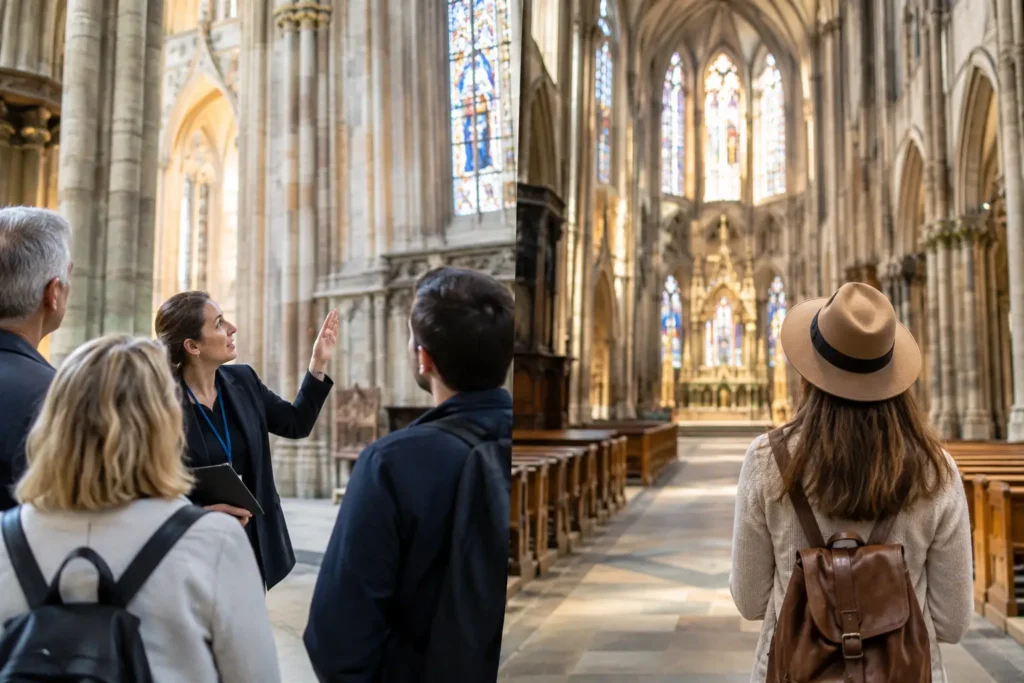
The moment you step into Santiago de Compostela Cathedral, the difference between simply seeing it and understanding it becomes clear. A guided cathedral visit versus solo exploration is not about choosing the “right” kind of traveler. It is about deciding what you want from one of Galicia’s most meaningful places: freedom to move at your own pace, or the stories that bring every chapel, stone, and ritual to life.
For many visitors, the best choice depends on time, interests, and how much planning they want to take on. If your trip is short, if you are arriving from a cruise ship, or if this is your first time in Santiago, a local guide can turn a limited visit into a richer experience. If you enjoy lingering in silence and following your curiosity without a schedule, visiting independently may suit you better.
Guided cathedral visit versus solo: the real difference
A cathedral is not a museum where every essential detail is printed beside an object. Its meaning is layered into its architecture, the people who built it, the pilgrims who have arrived for centuries, and the ceremonies that still take place there. On a guided visit, those layers are explained as you walk.
A local guide can point out details that are easy to miss: why the cathedral became the final destination of the Camino de Santiago, how the building changed across Romanesque, Gothic, and Baroque periods, or what the Portico of Glory represents. You are not just looking at an extraordinary facade or a gleaming altar. You are seeing how faith, art, politics, and pilgrimage shaped the city around it.
Going solo offers a different value. You decide when to arrive, what to focus on, and how long to stay. Perhaps you want to attend Mass, sit quietly in a side chapel, or spend an hour studying one section that catches your attention. There is no need to keep pace with a group.
Neither option is automatically better. The practical question is whether you value interpretation and organization more than total flexibility.
What a guided visit adds
The greatest advantage of a guided cathedral visit is context. A qualified local guide connects the building to Santiago itself: the medieval streets outside, the arrival of pilgrims in Obradoiro Square, and the traditions that continue long after the walk ends.
This is especially valuable if you have not researched the cathedral in advance. Without an explanation, visitors often recognize that a place is important but leave without knowing why a particular doorway matters, how a restoration changed the interior, or which stories are history, tradition, or popular legend. Good guides make those distinctions clearly and keep the experience engaging rather than academic.
Guided visits also simplify logistics. Cathedral access, religious services, restoration work, and special events can affect what is open and when. A scheduled experience gives you a clear meeting point, a defined duration, and someone who can adapt the visit to current conditions. That reassurance matters when you are fitting Santiago between a hotel check-in, a day trip through Galicia, or a return time to a cruise port.
For international visitors, language can be another deciding factor. Joining a tour in a language you understand well makes the history more immediate and makes it easier to ask questions. This can be particularly useful for families and mixed groups, where one person may have researched every detail while another simply wants a clear, enjoyable introduction.
A guided experience is also social without requiring a private group. You may share the visit with fellow travelers, hear questions you had not considered, and enjoy the energy of arriving together at a place that means so much to so many people.
When a guide is worth it
Choose a guide if the cathedral is a priority on your itinerary rather than a quick stop. It is often the better option for first-time visitors to Santiago, Camino travelers who want to understand the destination they have reached, and anyone with only a few hours in the city.
It also makes sense if you prefer to reserve ahead. Knowing your plan is confirmed before you arrive leaves more time to enjoy the old town, choose a restaurant, or continue toward another Galician destination. Tour Galicia designs guided experiences around this kind of practical travel planning, with local knowledge and clear organization from the start.
What you gain by visiting solo
Independent cathedral visits appeal to travelers who like to make their own discoveries. You can approach the building at a quiet time, revisit it after walking the historic center, or combine the visit with a slow morning in the surrounding squares. There is a particular pleasure in entering with no agenda and letting the atmosphere guide your attention.
Solo visits can also be more economical, depending on what spaces you plan to see and what access is available at the time. If your main goal is to admire the exterior, step inside for a brief visit, or attend a service, you may not need a guided experience.
The pace is entirely yours. Photography lovers may want to wait for the right light outside. Architecture enthusiasts may prefer to read beforehand and examine features closely. Travelers seeking a spiritual moment may not want commentary at all. In these cases, independent travel gives you room to experience the cathedral personally.
Still, freedom requires a little preparation. Check opening times close to your visit, be aware that worship takes priority over tourism, and allow extra time during busy periods. Santiago can feel especially lively on weekends, holidays, and during peak Camino season. If a particular area matters to you, do not assume it will be accessible on the day.
The trade-off: more freedom, more homework
A solo visit works best when you are comfortable researching basic history and handling changes to your plan. You may want to read about the cathedral before arriving, download an audio guide if available, and understand the etiquette expected in a working religious space.
You should also be realistic about what you will remember. Many travelers leave with beautiful photographs but only a general impression of what they saw. That may be enough for a relaxed city break. But if this is a once-in-a-lifetime Camino journey, the added perspective of a guide can feel more valuable than the savings.
How to choose based on your travel style
Think first about your schedule. A guided visit is ideal when your time is fixed and you want a reliable plan. This is common for visitors on a day trip from A Coruña, travelers with a packed Galicia itinerary, and cruise passengers who need to be back at the port on time. A planned route removes guesswork.
Then consider your interest level. If you are curious about the Camino, sacred art, local history, or the evolution of Santiago, guided interpretation will likely deepen the experience. If you mainly want to feel the atmosphere of the place and take your time, going solo can be more satisfying.
Your group matters too. Families often appreciate a guide who can make centuries of history accessible and keep the visit focused. Couples may choose a tour for the stories, then return later independently for a quieter look. Friends traveling together may prefer the convenience of meeting a guide and letting someone else handle the route.
There is also a middle path. Take a guided tour first, then explore the cathedral surroundings on your own. After learning the larger story, the streets around the cathedral, the pilgrims arriving in the square, and the details of the old town tend to feel more connected. You keep the context while still creating unstructured time for your own discoveries.
Make the cathedral part of a better Santiago day
Whether you visit with a guide or independently, avoid treating the cathedral as an isolated attraction. Give yourself time before or after to walk through the historic center, pause in Obradoiro Square, and notice how the city rises and falls around the pilgrimage route. Santiago is best understood on foot, at a pace that allows room for unexpected corners and small details.
Wear comfortable shoes, arrive with respectful expectations, and leave space in your schedule. A cathedral visit can be brief, but its impact often stays with you longer when you are not rushing to the next stop.
If you want the history explained with clarity and local perspective, book a guided visit that fits your schedule. If you prefer a quiet, self-directed moment, go solo with a little preparation. Either way, allow the cathedral to be more than a photo stop: it is one of the places where Galicia’s living history is easiest to feel.