

A Finisterre Tour for Galicia’s Wild Coast
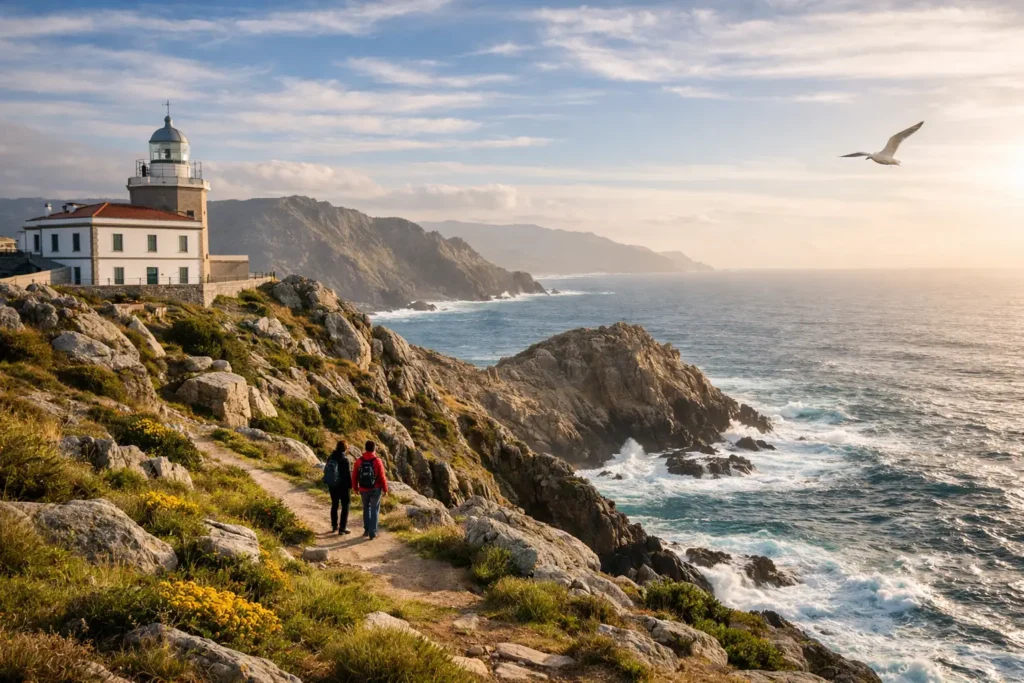
The road to Cape Finisterre is not just a route to a lighthouse. It is a journey through fishing villages, granite coastlines, Atlantic beaches, and the stories that give the Costa da Morte its unforgettable character. A finisterre tour lets you experience this western edge of Galicia in one well-organized day, without the pressure of driving unfamiliar roads or trying to fit every stop into a map.
For travelers staying in Santiago de Compostela, it is one of the most rewarding day trips in the region. You leave the city behind, follow the coast, and arrive at a place long considered the end of the known world. The scenery is dramatic, but the experience is also full of small details: harbor boats, stone granaries, local seafood traditions, and the changing color of the Atlantic.
Why take a Finisterre tour from Santiago?
Finisterre, also known by its Galician name Fisterra, sits around 55 miles west of Santiago de Compostela. The distance may look simple on a map, but the best parts of the route are spread across the coast. Reaching Cape Finisterre is only one part of the day. The journey is what makes this excursion special.
A guided trip gives you a clear itinerary and transport from the city center, while leaving room to enjoy the places that make the Costa da Morte feel distinct from the rest of Galicia. Rather than watching for turns, parking in small coastal towns, or calculating your return after sunset, you can focus on the landscape and the guide’s local perspective.
This format works especially well for independent travelers, couples, families, and groups of friends who want to see more than one destination in a day. It is also a practical choice if you do not plan to rent a car during your stay in Santiago.
What you can expect along the Costa da Morte
Every itinerary has its own rhythm, and stops may vary according to the season, traffic, weather, and local conditions. Still, a full-day Finisterre and Costa da Morte excursion generally combines several of the region’s essential landscapes.
Coastal villages with a working harbor
The coast of western Galicia is shaped by the sea, and towns such as Muxía or Finisterre show that connection immediately. You may see fishing boats returning to port, nets piled along the dock, and restaurants serving the catch of the day. These are not museum villages. They are living coastal communities where daily life still follows the Atlantic.
A local guide helps turn a short walk into a richer visit. The name Costa da Morte, or Coast of Death, is not simply a dramatic label. It refers to a coastline known for strong currents, sudden weather changes, and a long history of shipwrecks. Understanding that history gives real context to the cliffs and open water in front of you.
Waterfalls, beaches, and open Atlantic views
Depending on the route, the day can include a stop near Ézaro Waterfall, where the Xallas River reaches the sea. It is a striking contrast: fresh water, rock, and Atlantic coast in the same setting.
You may also visit wide beaches such as Langosteira, where the horizon seems to stretch forever. In summer, these stops bring bright light and beach activity. On a cloudy day, they show another side of Galicia: powerful waves, misty headlands, and an atmosphere that feels almost cinematic. Neither version is less authentic. Galicia’s weather changes quickly, and that is part of its appeal.
Cape Finisterre and its lighthouse
Cape Finisterre is the moment many visitors remember most. The lighthouse stands on a rocky headland facing the Atlantic, where the land appears to stop abruptly. For centuries, this location carried a powerful symbolic meaning. Before modern maps, it was seen as one of the western limits of the world.
For pilgrims who have completed the Camino de Santiago, Finisterre can feel like a natural extension of their journey. But you do not need to walk the Camino to appreciate the place. The view itself is enough: cliffs below, sea in every direction, and the sensation of standing at the far edge of Europe.
It is worth approaching this stop with realistic expectations. Cape Finisterre is exposed to the elements, so wind is common even on pleasant days. The best experience comes from dressing for the coast and allowing yourself time to look, walk, and take in the setting rather than treating the lighthouse as a quick photo stop.
Is a Finisterre and Costa da Morte trip right for you?
This is a good choice if you want a full day of scenery, local culture, and several stops beyond Santiago. It is less suitable for travelers looking for a slow beach day or a long lunch in one town. A shared excursion follows a schedule because it covers a considerable distance and gives everyone time at multiple locations.
The trade-off is clear. Traveling independently gives you complete flexibility, but it also requires a rental car, confidence on rural roads, parking patience, and advance planning. A guided day tour gives you less control over the exact pace, but much more ease. For many visitors, particularly those with only two or three days in Galicia, that is a worthwhile exchange.
Families should consider the length of the day and the interests of younger travelers. The changing stops, beaches, and lighthouse views can keep children engaged, but this is not a short outing. Travelers with reduced mobility should review the walking involved at each location, as coastal viewpoints can include uneven surfaces and exposed paths.
How to prepare for the Atlantic coast
The Costa da Morte rewards practical packing. Weather can shift between Santiago and the coast, and a sunny morning does not guarantee a warm afternoon at Cape Finisterre. Bring a light waterproof layer, comfortable walking shoes, water, and sun protection. A windproof jacket is useful in every season.
If you plan to take photographs, keep your phone or camera protected from sea spray and rain. The most impressive views are often the least sheltered ones. In cooler months, layers are more useful than one heavy coat, since temperatures can feel different in the city, in the vehicle, and at the exposed cape.
For lunch, check how your chosen itinerary handles free time and meal stops. Some travelers prefer a quick local lunch to maximize sightseeing, while others want time to try seafood in a coastal town. There is no wrong approach, but knowing the schedule before departure helps you choose comfortably.
Choosing a guided Finisterre tour
When comparing options, look beyond the destination name. A quality excursion should clearly explain its departure point, approximate duration, included transport, planned stops, guide language, and cancellation conditions. These details matter more than a vague promise of seeing the coast.
A knowledgeable local guide also changes the day. The coastline is beautiful on its own, but the stories of pilgrimage, shipwrecks, fishing traditions, and Galician identity add depth to each viewpoint. You are not simply passing through a landscape. You are seeing why it matters to the people who live there.
For travelers based in Santiago, Tour Galicia organizes guided excursions designed to make this long day feel straightforward: coordinated transportation, clear meeting information, and guides who know the route and its context. Booking in advance is especially sensible in high season, on weekends, and around major holidays, when demand for day trips from Santiago can be higher.
Make room for the unexpected
A trip to Finisterre is not about checking off a lighthouse and returning to the city. It is about seeing a different Galicia: salt in the air, boats in the harbor, weather moving over the water, and roads that lead toward a horizon with no visible end.
Leave a little space in your plans for that feeling. Whether the cape greets you with clear blue skies or Atlantic fog, the Costa da Morte has a way of making the journey itself the part you carry home.