

Galicia Transport Options for Easier Day Trips
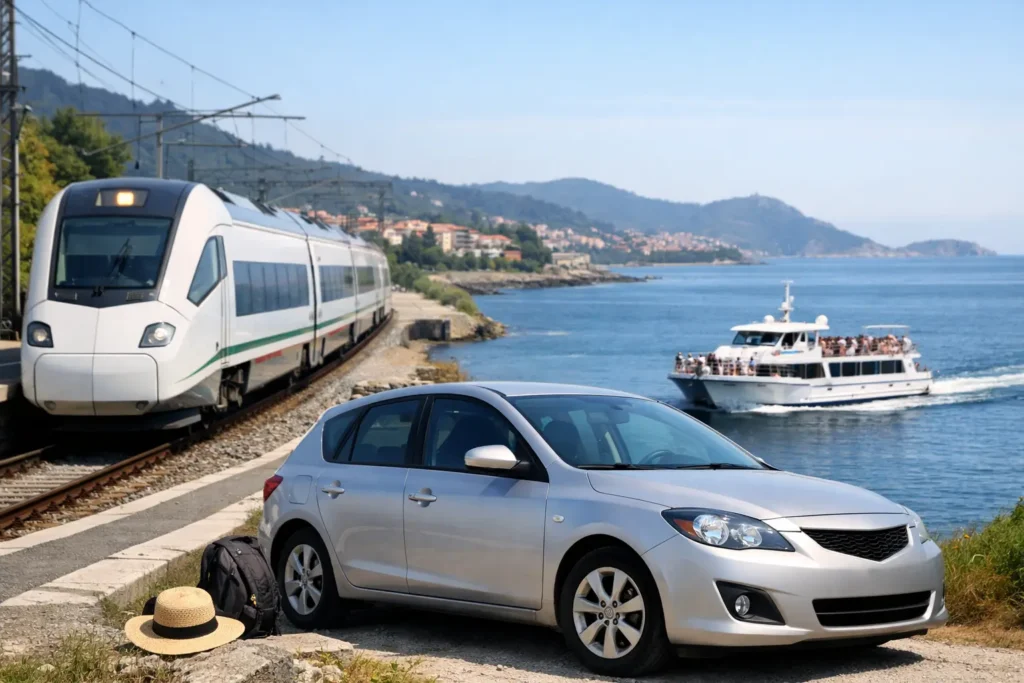
A map can make Galicia look deceptively simple. Santiago de Compostela, A Coruña, Vigo, Lugo, Finisterre, Ribeira Sacra, and the Rías Baixas all seem close enough to connect in a few quick hops. In reality, Galicia transport options depend on whether you are traveling between cities, reaching a coastal village, or trying to fit a memorable excursion into one free day.
The right choice is rarely just the cheapest one. It is the option that gives you enough time at the destination, works with your accommodation or cruise schedule, and lets you enjoy the landscape without spending the day decoding timetables. Here is how to choose with confidence.
Galicia transport options at a glance
For travel between Galicia's major cities, trains and intercity buses are usually practical. For airports, a prearranged transfer, public bus, taxi, or rental car may make sense depending on your arrival time. For places such as Finisterre, Costa da Morte viewpoints, the Rías Baixas, or the Ribeira Sacra, the most convenient answer is often a guided day trip or a car.
That difference matters. Rail is excellent for certain city-to-city routes, especially Santiago, A Coruña, Vigo, Ourense, and connections onward to Madrid. But many of Galicia's most memorable stops are spread across rural roads, estuaries, cliffs, monasteries, and small fishing towns. Public transportation can reach some of them, but it may not connect the stops you want on the same day.
Before booking anything, begin with three questions: Where are you sleeping? How much time do you have? Do you want the journey itself to be flexible, or would you rather have the route organized for you?
Traveling between Galicia's main cities
Train: best for fast city connections
Train travel is a strong choice when your itinerary centers on urban destinations. Santiago de Compostela, A Coruña, Vigo, Ourense, Lugo, and Ferrol have rail connections, although frequency and journey times vary by route. It is especially useful for travelers combining Galicia with Madrid or continuing through northern Spain.
For a Santiago to A Coruña visit, the train can be an efficient way to arrive near the city center without dealing with parking. Vigo is also well connected to Santiago and other principal cities. If you are carrying luggage, traveling as a couple, or prefer not to drive after a flight, rail keeps the day simple.
The trade-off is that a train station is only the beginning of the journey. A rail ticket will not take you directly to a lighthouse on the Costa da Morte, a boat departure in the Rías Baixas, or a viewpoint over the Sil Canyon. Check the final distance from the station to the places you actually want to see before treating the train as a complete transport plan.
Intercity bus: useful, but check the return trip first
Buses cover routes that trains do not, including many smaller towns. They can be economical and are often the only public transportation choice for particular coastal or inland areas. From Santiago, for example, bus connections can help independent travelers reach destinations in the province and beyond.
Still, bus schedules deserve a closer look in Galicia. A route may run only a few times per day, change by season, or arrive in town without allowing enough time to explore before the last return departure. This is particularly relevant on Sundays, public holidays, and outside peak summer months.
If your goal is one town, a bus can work very well. If your goal is a full day of beaches, villages, scenic stops, and local food, public bus travel can turn a relaxed itinerary into a race against the clock.
Taxi and private transfer: best for fixed schedules
Taxis are readily available in major cities and at transport hubs, while private transfers can be arranged for airport arrivals, hotel-to-hotel travel, and groups with a specific timetable. This option is worth considering when you arrive late, have children or substantial luggage, or need to make a cruise boarding time.
For short routes, a taxi can be the easiest solution. For a full-day route with several stops, the cost can rise quickly. Ask whether waiting time, tolls, and return travel are included, rather than assuming a one-way fare covers the entire plan.
Should you rent a car in Galicia?
A rental car offers the greatest independence. It is ideal for travelers who want to stay in rural accommodations, stop at quiet beaches, follow wine-country roads, or build a multi-day route beyond the main cities. Galicia rewards unhurried detours: a roadside mirador, a village market, or a small harbor that would be difficult to reach on a fixed schedule.
But driving is not automatically the best choice for every visitor. Historic centers in Santiago, A Coruña, Lugo, and other towns can have restricted access, narrow streets, and limited parking. Coastal roads may be winding, and weather can change quickly, especially outside summer. If one person in your group will do all the driving, that person may miss part of the experience.
A car is most valuable when you will use it for two or more days or when your accommodation is outside a city center. For a single day from Santiago to a popular route, collecting and returning a rental car, finding parking, and planning each stop can take more effort than expected.
Guided excursions: the practical option for scenic routes
A guided excursion is designed for the part of Galicia where transportation is least straightforward: destinations that are spectacular precisely because they are dispersed. It combines transportation with a planned route, local context, and enough structure to make a full day feasible.
From Santiago de Compostela, day trips can make destinations such as Finisterre and Costa da Morte, the Rías Baixas and A Toxa, Ribeira Sacra, Playa de las Catedrales, Lugo, Ribadeo, A Coruña, and Betanzos accessible without renting a car. Rather than choosing between several bus connections or limiting yourself to one stop, you can follow an itinerary that links the highlights logically.
This is a particularly good fit for independent travelers who want to see more than one place but do not want to manage the logistics. It also helps families and groups avoid the recurring question of who is driving, where to park, and whether the next viewpoint is actually reachable.
The trade-off is flexibility. A shared excursion follows a schedule and includes selected stops, so it is not the best format if you want to spend an entire afternoon in one village or change plans at the last minute. For travelers who prefer a personalized pace, a private route can be a better balance between comfort and freedom.
With Tour Galicia, travelers can join organized excursions led by local guides, with clear meeting points, immediate confirmation, and cancellation available up to 24 hours before departure. For many visitors, that removes the uncertainty while keeping the day focused on Galicia itself.
Airport transportation: plan before you land
Galicia has airports in Santiago de Compostela, A Coruña, and Vigo. The best onward transportation depends largely on your landing time and hotel location. Public airport buses are often useful during normal operating hours, while taxis and private transfers are more dependable for early arrivals, late flights, or accommodations outside the main center.
Santiago Airport is a common arrival point for travelers staying in Santiago or beginning a wider Galicia itinerary. If you plan to leave for a day trip the morning after landing, avoid building an overly ambitious first evening. Flight delays, baggage collection, and hotel check-in can make a simple transfer feel much more valuable than an extra item on the itinerary.
For travelers arriving in A Coruña or Vigo, check whether your destination is truly closer by road, not just by looking at the map. Galicia's geography and road network mean that the nearest airport is not always the quickest route to every attraction.
Transportation for cruise passengers in Vigo and A Coruña
Cruise visitors have a different calculation: the essential transport question is not only where to go, but how to return to the port with time to spare. Independent taxis and private drivers can work for short, tightly planned outings. However, routes with several stops require careful timing, particularly when traffic, weather, or a busy port area affects the day.
An excursion built around cruise schedules provides transportation coordinated with the available shore time and a planned return to the departure port. In A Coruña, that may mean making the most of the city and nearby highlights. In Vigo, it can open access to the distinctive landscapes of the Rías Baixas without relying on multiple local connections.
Always keep your all-aboard time separate from your ship's arrival time, and allow a margin for getting through the port area. The best shore day is one that feels generous, not rushed.
How to choose the right option for your itinerary
Choose the train when you are moving directly between major cities and want an efficient, low-stress connection. Choose a bus when it serves a single destination on a timetable that leaves room for your visit. Rent a car when you have several days, are comfortable driving, and want rural freedom. Choose a guided route when the destination involves several scenic stops, limited public transportation, or a day you would rather spend looking out the window than studying routes.
Galicia is best experienced with time for the unexpected: mist lifting from an estuary, a market appearing around a corner, or a guide explaining why a seemingly quiet stone village matters. Pick transportation that leaves room for those moments.